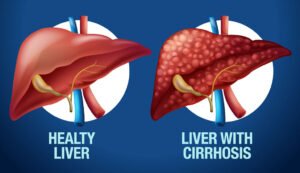

Obstructive jaundice is yellowing of the skin and the whites of the eyes caused by a blockage in the bile ducts, the tubes that carry bile from the liver to the intestine. When bile cannot flow, a yellow pigment called bilirubin builds up in the blood. Obstructive jaundice always needs medical assessment, because the cause may be a gallstone that can be removed, or a more serious condition such as cancer.
Key facts
- Jaundice is a sign, not a disease. Obstructive jaundice means bile flow is blocked.
- Gallstones are the most common cause.
- Dark urine, pale stools and itching are typical.
- Jaundice with fever and chills can signal a serious bile duct infection that needs urgent treatment.
- Ultrasound is usually the first test.
Types of jaundice
Jaundice can occur for three broad reasons:
- Before the liver: too many red blood cells breaking down, as in sickle cell disease or severe malaria
- In the liver: liver damage from hepatitis, alcohol, medicines or cirrhosis
- After the liver (obstructive): a blockage in the bile ducts, the subject of this guide
Causes of obstructive jaundice
- Gallstones that move from the gallbladder into the common bile duct
- Cancers of the pancreas, bile ducts (cholangiocarcinoma), gallbladder or the area where the bile duct enters the intestine
- Narrowing (stricture) of the bile duct after surgery, injury or inflammation
- Inflammation of the pancreas (pancreatitis) pressing on the duct
- Parasites, such as roundworms (Ascaris) or liver flukes, which occasionally block the ducts
- Enlarged lymph nodes or cysts pressing on the ducts
- Biliary atresia in newborn babies, where the bile ducts are absent or blocked
Symptoms
- Yellow skin and whites of the eyes. On darker skin, it is easiest to see in the eyes, palms and inside the mouth.
- Dark, tea- or cola-coloured urine
- Pale, clay-coloured stools
- Itching all over the body
- Pain in the upper right abdomen, especially with gallstones
- Loss of appetite and weight loss, particularly with cancer
- Fever and chills if the bile ducts are infected (cholangitis)
Painless jaundice with weight loss in an older adult is a warning sign of cancer and should be investigated quickly.
Diagnosis
- Blood tests: bilirubin, liver function tests, clotting, blood count, and tests for hepatitis
- Abdominal ultrasound to look for widened bile ducts and gallstones
- CT scan or MRCP (a special MRI) to find the exact site and cause of the blockage
- Endoscopic ultrasound or ERCP, using a camera passed through the mouth into the intestine, which can also take samples and treat the blockage
Treatment
Treatment depends on the cause:
- ERCP: gallstones in the bile duct can be removed, and a stent can be placed to keep a narrowed duct open.
- Gallbladder removal (cholecystectomy), often by keyhole surgery, to prevent more gallstones causing problems.
- Surgery for tumours that can be removed, such as the Whipple procedure for some pancreatic cancers.
- Stents or drainage to relieve jaundice and itching when a cancer cannot be removed.
- Antibiotics and urgent drainage for cholangitis.
- Treatment of parasites with anti-worm medicines.
- Surgery in infancy for biliary atresia.
Medicines can help relieve itching while the cause is treated. Do not use herbal “jaundice cures” or local remedies, which can delay diagnosis and damage the liver.
When to see a doctor
See a doctor promptly for any yellowing of the skin or eyes, dark urine or pale stools. Seek emergency care if jaundice comes with fever and shivering, severe abdominal pain, confusion or drowsiness, or vomiting blood. A newborn baby whose jaundice lasts beyond two weeks, or who has pale stools, needs urgent assessment.
Frequently asked questions
Is jaundice contagious?
Jaundice itself is not contagious, but some causes, such as hepatitis A and B, can be spread.
Will jaundice go away on its own?
Obstructive jaundice usually does not resolve until the blockage is treated. Always get it checked.