
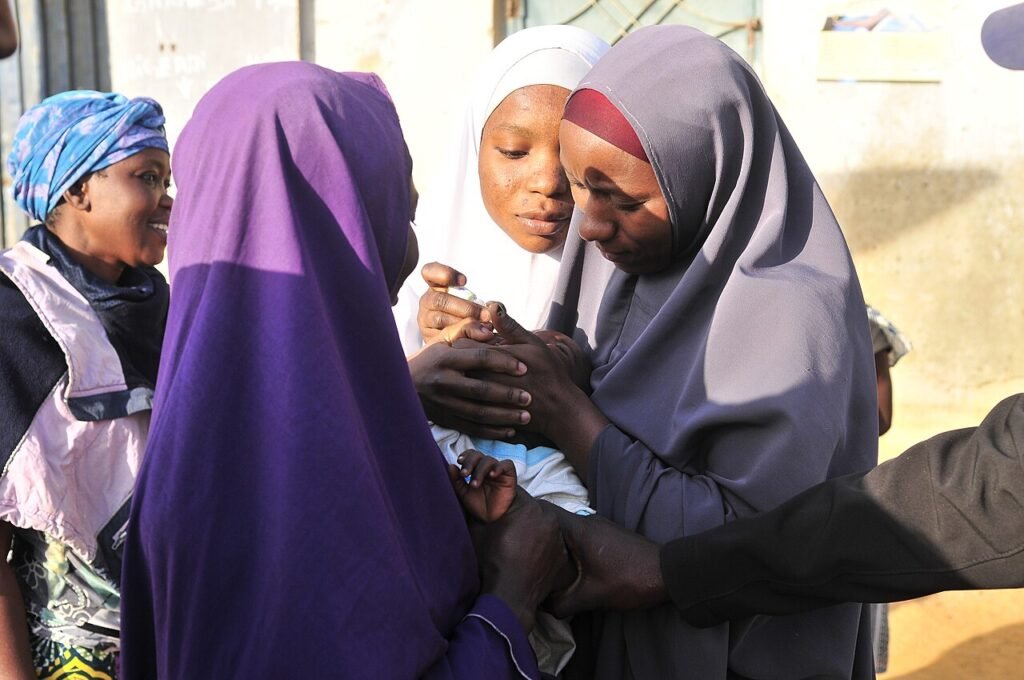
Vaccines protect children against serious diseases that once killed or disabled millions, including measles, whooping cough, polio, tuberculosis and yellow fever. In Nigeria, routine childhood vaccines are free at government health facilities under the National Programme on Immunization, run by the National Primary Health Care Development Agency (NPHCDA). This guide explains the schedule and what to expect.
Key facts
- Routine childhood vaccines are free at public primary health care centres.
- The first vaccines are given at birth, and most doses are completed by 15 months.
- Keep your child’s immunisation card safe and bring it to every visit.
- Mild fever or a sore leg after vaccination is normal and short-lived.
- If your child misses a dose, go back as soon as possible. There is no need to restart.
Interactive tool
Your baby's vaccination dates
Enter your baby's date of birth to see when each routine clinic visit is due.
Based on Nigeria's routine immunisation schedule. Some vaccines vary by state or are being introduced. Your child's vaccination card and health worker are the final guide. If a visit is missed, go as soon as possible – there is no need to restart.
The routine schedule
The schedule below reflects Nigeria’s national routine immunisation programme. Vaccines are sometimes added or changed, and some are given only in certain states, so your health centre and your child’s card are the final guide.
At birth
- BCG – protects against severe forms of tuberculosis in young children
- Oral polio vaccine (OPV 0)
- Hepatitis B birth dose – best given within 24 hours of birth. See our hepatitis B guide.
6 weeks
- Pentavalent vaccine (dose 1) – protects against diphtheria, tetanus, pertussis (whooping cough), hepatitis B and Haemophilus influenzae type b
- Pneumococcal conjugate vaccine (PCV, dose 1) – protects against pneumonia and meningitis
- Oral polio vaccine (OPV 1)
- Rotavirus vaccine (dose 1) – protects against severe diarrhoea
10 weeks
- Pentavalent (dose 2), PCV (dose 2), OPV 2 and rotavirus (dose 2)
14 weeks
- Pentavalent (dose 3), PCV (dose 3), OPV 3
- Inactivated polio vaccine (IPV) – an injected polio vaccine that strengthens protection
- Rotavirus (dose 3), depending on the vaccine brand used
6 months
- Vitamin A supplement, repeated every six months up to age five
9 months
- Measles vaccine (dose 1). See our measles guide.
- Yellow fever vaccine – one dose gives lifelong protection
- Meningitis A vaccine in states within the meningitis belt
15 months
- Measles vaccine (dose 2)
Other vaccines
- HPV vaccine for girls aged 9 to 14, introduced in Nigeria in 2023, protects against cervical cancer. See our cancer guide.
- Malaria vaccine is being introduced for young children in some states. Ask your health centre whether it is available.
- Tetanus-diphtheria (Td) vaccine is given to women of childbearing age and during pregnancy to protect mothers and newborns.
- Supplementary campaigns for polio, measles and other diseases are held regularly. It is safe for children to receive these extra doses.
What to expect after vaccination
- Soreness, redness or swelling where the injection was given
- Mild fever and fussiness for a day or two
- A small sore at the BCG site a few weeks later that heals to leave a small scar. This is normal.
Breastfeed often and give paracetamol if advised by a health worker. Do not apply hot compresses, herbs or other substances to the injection site.
Serious reactions are very rare. Seek care immediately if your child has difficulty breathing, swelling of the face, a high fever that does not come down, fits, or is unusually drowsy.
Common questions from parents
Is it safe to give several vaccines on the same day?
Yes. Children’s immune systems handle multiple vaccines easily, and combining them means fewer visits and earlier protection.
Can my child be vaccinated with a cold or mild fever?
Yes. A mild illness is not a reason to delay. Tell the health worker if your child has a high fever or is very unwell.
My child missed a dose. Do we start again?
No. Go to the health centre as soon as possible and continue from where you stopped.
Do vaccines cause autism or infertility?
No. Large studies involving millions of children have found no link between vaccines and autism, and vaccines do not cause infertility.
Tips for parents
- Keep the immunisation card in a safe place, and take a photo of it.
- Ask the health worker to write the date of the next visit on the card.
- Attend even if you are unsure. Health workers can check what your child needs.
- Vaccines are free. You should not be asked to pay for routine vaccines at public facilities.
When to see a health worker
Visit your nearest primary health care centre for your child’s first vaccines soon after birth, and at each scheduled date. See a health worker if your child has a reaction that worries you.
Related guides


Sources
- World Health Organization: Vaccines and immunization
- World Health Organization: Immunization coverage fact sheet
- National Primary Health Care Development Agency (Nigeria)
