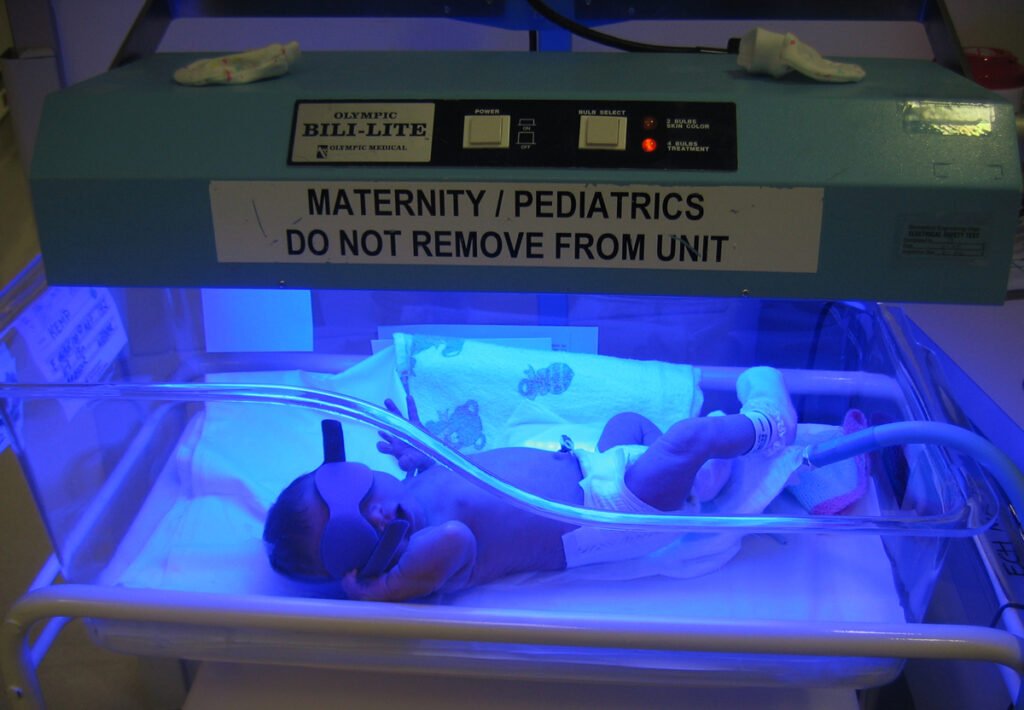
Newborn jaundice is yellowing of a baby’s skin and the whites of the eyes. It is very common in the first week of life because a newborn’s liver is still immature and cannot clear a yellow substance called bilirubin quickly. Most cases are mild and go away on their own within two weeks. However, very high bilirubin can cause brain damage (kernicterus), deafness and cerebral palsy, so severe jaundice must be treated quickly.
Key facts
- Jaundice in the first 24 hours of life is never normal and needs urgent care.
- On darker skin, check the whites of the eyes, gums, palms and soles.
- Frequent breastfeeding helps the baby clear bilirubin.
- Phototherapy (special blue light) is the main treatment for significant jaundice.
- Do not use sunlight, herbs, glucose water or other home remedies instead of medical care.
Causes
Common and usually harmless
- Physiological jaundice: appears after the first 24 hours, peaks around day 3 to 5 and fades within 2 weeks
- Breastfeeding-related jaundice: linked to the baby not feeding enough in the first days, or to substances in breast milk. Keep breastfeeding and get help with feeding.
Needs medical attention
- G6PD deficiency: an inherited condition common in Nigeria, where red blood cells break down more easily. Mothers and babies should avoid naphthalene (camphor/mothballs), some herbal remedies and some medicines.
- Blood group incompatibility between mother and baby (rhesus or ABO)
- Infection
- Prematurity
- Bruising from a difficult birth
- Liver or bile duct problems, including biliary atresia, which causes jaundice lasting beyond 2 weeks with pale stools. See our obstructive jaundice guide.
How to check your baby
- Check in good natural daylight.
- Look at the whites of the eyes, the gums and inside the mouth, and the palms and soles.
- Gently press on the skin of the forehead or chest for a moment; if the skin looks yellow when you release, jaundice may be present.
- Jaundice usually starts at the face and spreads down the body as levels rise. Yellowing below the tummy, or on the palms and soles, suggests higher levels.
Danger signs
Take your baby to a hospital immediately if:
- Jaundice appears in the first 24 hours
- The yellow colour is spreading or deepening, or reaches the palms and soles
- The baby is very sleepy, hard to wake or not feeding well
- The baby is floppy or stiff, has a high-pitched cry, arches the back, or has fits
- The baby has pale, chalky stools or dark urine
- Jaundice lasts more than 2 weeks (3 weeks in premature babies)
Diagnosis
A health worker measures bilirubin with a skin meter or a blood test. They may also check the mother’s and baby’s blood groups, G6PD status and signs of infection.
Treatment
- Frequent feeding: breastfeed 8 to 12 times in 24 hours to help the baby pass bilirubin in the stool.
- Phototherapy: the baby is placed under special blue lights with eyes covered. The light breaks down bilirubin so it can be removed. It is safe and effective.
- Exchange blood transfusion: for very high levels that do not respond to phototherapy.
- Treating the underlying cause, such as infection.
Avoid these
- Sunlight as treatment: it is not reliable for significant jaundice and can cause overheating and sunburn. It can also delay proper treatment.
- Glucose water or herbal drinks: they do not lower bilirubin and reduce breastfeeding.
- Camphor, naphthalene and some traditional remedies: these can trigger severe jaundice in babies with G6PD deficiency.
Frequently asked questions
Should I stop breastfeeding?
No. In most cases, continuing and increasing breastfeeding is best. Follow your health worker’s advice. See our breastfeeding guide.
Can jaundice come back?
Mild jaundice sometimes lasts a few weeks in breastfed babies. Any jaundice after two weeks should be checked.